This article discusses the evacuation of Kilmainham Gaol in 1910.
What if Kilmainham Gaol would suddenly vanish from the public’s gaze and lose face during our country’s most defining moments? This article will attempt to answer these questions by discussing how Kilmainham Gaol in fact looked destined to unfulfill its role as the Bastille of Irish prisons due to its evacuation in 1910.
Lack of foresight or the end of an era?
The evacuation of Kilmainham Gaol 1910
Kilmainham Gaol’s history in many respects mirrors Ireland’s history. The Gaol walls on Inchicore road capture and hold together the segments of many important aspects of our country’s history, both social and political. Within the four boundary walls, the fabric of our country’s past was woven together changing Irish history forever. All the various fragments of our country’s chequered past are plain to see in the corridors and cells of this national monument. But what if this legacy had been unfulfilled? What if Kilmainham Gaol would suddenly vanish from the public’s gaze and lose face during our country’s most defining moments? This article will attempt to answer these questions by discussing how Kilmainham Gaol in fact looked destined to unfulfill its role as the Bastille of Irish prisons due to its evacuation in 1910.
On the 4 February 1910, Kilmainham Gaol’s epitaph was written in the national newspapers. Mr J. B. Dougherty, Chairman of the General Prisons Board, with the authority vested in him from the Lord Lieutenant-General and General Governor of Ireland declared in the national newspapers of 8 February 1910 that Kilmainham Gaol was to be evacuated. His explanation for the order was quite frank and consistent with rigid British administration of the time stating that ‘it seems right to Us, for the purpose of effecting greater economy and convenience in the public service and at the same time preserving due efficiency’.[1] The explanation given by the General Prisons Board in their report for 1909-1910 suggests that the evacuation was in line with ‘the policy of concentration of prisoners, which had been rendered possible owing to the diminution that has taken place in the number in the number of prisoners and increased facilities’. In other words, increased space and less demand for this space meant unnecessary expenses. In 1841 Mr. Francis White, the Inspector General of Prisons, noted that there were ‘nine prisons in Dublin including Kilmainham; namely, Newgate, Richmond Bridewell, Grangegorman penitentiary, the Sheriff’s prison, City Marshalsea, Four Court’s Marshalsea, St. Sepulchre’s Manor prison and Smithfield penitentiary’ which was at that stage unoccupied.[2] This list did not include Mountjoy prison (1850) and Arbour Hill prison (1848). So by 1910 when Dougherty’s order was published there were eleven prisons under the control of the General Prisons Board in the greater Dublin area including Kilmainham.
The General Prisons Board was created in 1877 under the General Prisons (Ireland) Act. The G.P.B. began to fulfil its new role on the 9 November 1877 and was made up of a Chairman, a Vice-Chairman, a third salaried member and an honorary member.[3] The act centralised all powers to the board that had previously been distributed between various bodies such as the Convict Prisons Board, an Inspectorate of local prisons, grand juries and local authorities. The number of prisons transferred from the local authorities to the G.P.B on 1 April 1878 was 38 county and borough gaols and 95 bridewells including Kilmainham Gaol.[4] By the time Kilmainham’s cells were declared vacant for the first time since its opening in 1796, only 15 prisons would remain open in Ireland by 1910 including Cork, Tralee and Mountjoy. Ninety bridewells had also ceased to function leaving just five remaining to serve the rest of the country including Mallow, Ballina and Newry.[5] Was this case of prison closures largely confined to Ireland?
It seems that the Irish closures were following a coherent line from their English counterparts. In the same year that the G.P.B was set up in Ireland a radical shakeup was about to begin of the British penal system. In July 1877, following royal ascent, the path was laid clear for the Prisons Act of 1878. Under the terms of this new act:
‘the local authorities’ obligations with respect to prisons ceased. Local prisons became the responsibility of the Home Secretary, who was to appoint up to five Prison Commissioners to superintend them. The Secretary of State was also given the power to discontinue prisons’. [6]
The man tasked with this survey of prison closures was Edmund du Cane, Surveyor-General of Prisons. The blueprint which the authorities gave du Cane was simple – fewer larger holdings with a more even distribution. Du Cane acted swiftly on the matter and as early as October 1875, he produced a preliminary list of closures, with fifty-four prisons to be closed and sixty-two retained. By 1895, there were fifty local prisons in England, including Newgate, and a further seven in Wales. The daily average population of local prisons fell from 20,833 in 1878 to 13,604 in 1895.[7] The GPB in Ireland would not be immune to this shake-up. A Royal Commission was appointed five years after the formation of the GPB and reported back two years later in 1884 on the conditions of prisons in Ireland. Not surprisingly, they recommended:
the reduction of the number of prisons, the reconstruction of some prisons, the closing of Bridewells, the establishment of Lock-ups or legalised Police Cells, and the formation of a Public Works Prison for the whole of the Male Convicts.[8]
By the time the closures had been implemented in 1910 a more efficient and economic prison service was now at the disposal of the GPB. They now controlled 1 convict prison, 1 joint convict and local prison (Mountjoy), 15 local prisons and 6 bridewells. Two institutions of a reformatory nature also fell under their remit – the State Inebriate Reformatory at Ennis (1899) and the Borstal Institution in Clonmel (1909).[9]
They could easily afford to implement this period of closures in Ireland, as the first decade of the twentieth century was one of relative peace in the Irish political landscape. Although a cultural revolution was well under way in both the areas of the language revival, literature and national sports the era of social aggression through the Land Wars would be finally resolved through this decade with the implementation of both the Wyndham (1903) & Birrell (1909) Land Acts. The number of ordinary prisoners committed would also begin to gradually level out by the end of the decade to further allow room for reform of the prison system. In 1900, the total number of prisoners committed was 32,996. This was the highest number for the entire decade 1900-1910 with 31,587 prisoners being committed in 1909. According to the GPB report for 1910, ‘the number of ordinary prisoners committed to local prisons in Ireland, in 1909, was 31, 469. This shows a decrease of 1,363 on the number for 1908. The fact that the daily average number has not also decreased is attributed to a slight increase in the average length of sentences’. However, the GPB adds that 51% of the prison population spend less than a week in prison by 1910.[10] One would automatically assume that following the closures greater economic efficiency had prevailed. However, this was not always the case, as by 1911 the average cost per prisoner in local prisons in Ireland was still higher than those in English and Scottish prisons. It cost on average in Ireland during 1911 £5 5s 8d per prisoner, while in England it was £5 and in Scotland £4 5s 10d.[11] The last prisoner to appear on the Kilmainham Gaol records before its evacuation was one Wm Kane, a typical case study of the average prisoner in Irish prisons at the time.[12]
Wm Kane – Prisoner No. 198 – 19 years old – Born Kingstown – Labourer – Single – Roman Catholic – Committed 28th February – Committed from Kingstown Court by E.G Swifte Esq. – [Sentence – 7 days for profanities/obscene language] – transferred to Mountjoy on 28th February and was released after 6 days.
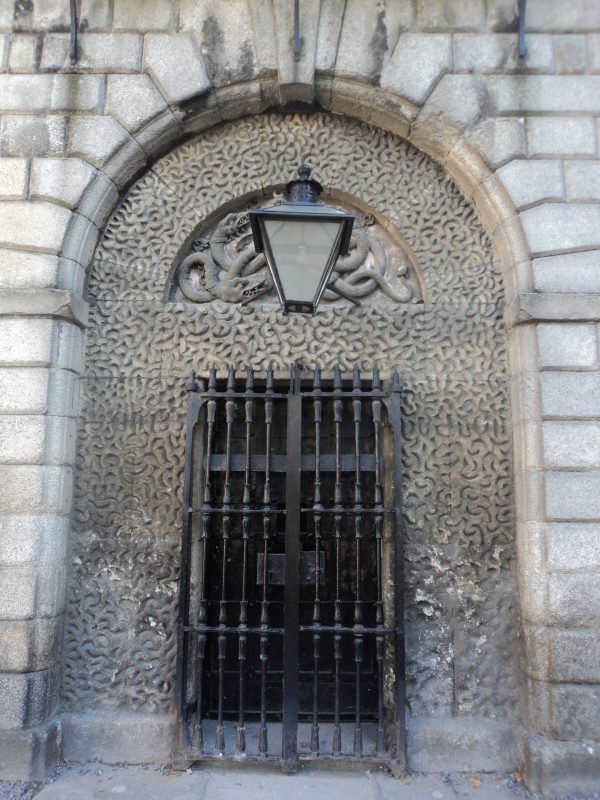
The records show that seven prisoners were admitted on the day of evacuation (28 February 1910) to Kilmainham Gaol. They were consistent with the minor crimes of the day loitering/begging/drunkenness/illegal bedding and a breach of the traffic act. Out of those seven prisoners, five were sentenced at Kingstown Court session. The second last prisoner to appear before the serpents of Kilmainham in 1910 was one John Harmon.[13]
John Harmon – Prisoner No. 197 – 43 years old – Born East Indies – Law Clerk – Roman Catholic – Committed 28th February – Committed from Kingstown Court – [Sentence – 4 days for drunkenness] – transferred to Mountjoy on 28th February and was released after 3 days.
Intoxication was a major contributor to the crimes and indeed sentences for a vast majority of the prison population. Thanks to the help of my former colleague and fellow historian Mícheál Ó Doibhilín (RIP), another one of Kilmainham’s evacuated final seven was tracked again on the Mountjoy registers and it appears that prisoner Felix Doran was re-committed to Mountjoy prison on a number of other occasions from the same crime as he was admitted to Kilmainham – intoxication. It seems to suggest that a policy of abstinence was not being forcefully encouraged by the various religious chaplains upon the prisoners during their initial admission to prison or their influence was minimal and drastic rehabilitation was needed for some. The last juvenile under 15 to be imprisoned in Kilmainham Gaol was Peter Early. The Children’s Act of 1908 stopped the imprisonment of children under the age of 14.[14]
Peter Early – Prisoner No. 557 – 14 ½ years old – Committed 25th May 1908 – [Sentence – 7 days for disorderly conduct] – served five days and was released after the fine was paid for one day.
Another important cost in running the prisons was also the maintenance of staff wages. Kilmainham Gaol alone by the time of its closure had employed 12 full-time positions as well as paying two local chaplains and a medical officer a salary. Those twelve positions included the Governor, a Chief Warder 1st Class, a clerk and nine ordinary warders.[15] All of these positions, except Governor, were abolished following the evacuation. As well as paying the men their salaries, they now had to also cover severance fees therefore, increasing the budget deficit. According to the Prisons Data for 1913-1914 the salaries afforded the various positions was as follows:
Ordinary Warders – 52l. increasing by 1l. annually to 70l, with uniform.
Cash allowances as follows are authorised in addition to their regular salaries for ordinary warders while employed on special duties
As Clerks, 10 at 10l., and 10 at 5l. per annum
Chief Warder 1st Class – 110l. per annum.
These stats do not include a figure for the Governors but in the case of deputy-governor, first class the figure is given at 200l. rising by 10l. per annum to 300l.
Chaplains played a very important role in the prisons systems in both the mental and spiritual rehabilitation of the prisoner. According to the prisons data of 1913, ‘prison chaplains are renumerated in accordance with the following scale. Daily average number of Church of Ireland, Roman Catholic or Presbyterian prisoners, as the case may be for the three years preceding date of vacancy’.[16]
3 to 25 prisoners £40 per annum
Over 25 to 60 prisoners £60 per annum
Over 60 to 120 prisoners £80 per annum
Over 120 prisoners £100 per annum
The prisons chaplains serving Kilmainham Gaol upon its closure were –
Reverend Patrick Canon Fee (P. P of St. James Parish, Dublin 8.)
Reverend Herbert McVittie Taylor (Church of Ireland Rector St. Jude’s Kilmainham)
Rev Fee would serve as parish priest of St. James’s from 1902 to 1917. His role of prison chaplain to Kilmainham was only bit part as when he queries, following the abolition of his post, is he entitled to a pension the response received from the GPB was as follows. ‘Acknowledge and state that having been appointed subsequent to 1st April 1878, and not being required to devote his whole time to the Service, he is ineligible for a pension’.[17] The closure of the gaol left the financial futures of many staff in doubt but also had serious ramifications unexpectedly for the local community also. The gaol had provided a form of valuable employment and income for the local residents of Inchicore and the community had grown around the employment that the gaol offered to the area. Rev. Taylor, the Church of Ireland chaplain for the gaol, had also been informed by the GPB that his salary was to cease from the 9 March 1910. This was to have serious ramifications for the relatively young and declining parish of St. Jude’s, Inchicore of which Rev. McVittie Taylor was attached to.
On 16 November 1861, St. Jude’s was established as a district curacy in St. James’s parish with the church being officially consecrated on 2 January 1864. The first incumbent of St. Jude’s was Reverend Thomas Mills who served from 1859 to 1900.[18] He had also acted as chaplain to Kilmainham Gaol and the garrison troops in the area and was instrumental in establishing the Church of Ireland parish of St. Jude’s. One of his successors, Rev. Taylor now had the unenviable task of trying to manage an ever-declining parish with rising debt. Rev. Taylor, who was instituted as incumbent to St. Jude’s on 1 February 1906, and who had received an M.A from Trinity College was now set to lose £40 per annum owing to the evacuation of Kilmainham Gaol. This decision did not go down lightly with the Select Vestry of the parish and they outlined their argument in support of Rev. Taylor writing to the GPB stating
There is a large debt on the Rectory, the interest & instalments of which are paid by the Rector. This with taxes, make his income less by about £76 per annum – the cheques payable to the Board of Works and Church Representative Body being at present £56. Now owing to the closing of Kilmainham Prison and abolition of the chaplaincy (without compensation) the Rector sustains an additional loss of £40 a year. This we consider a very serious matter and want to see what can be done to meet the case.[19]
The GPB had obviously not considered the impact that the closure would have on the local community and this wasn’t just in Inchicore but would also be a substantial problem in terms of employment and economics to the other areas affected by the prison closures.
The modus operandi for the plan of evacuation had been clearly laid out by the GPB for Kilmainham Gaol. From the time the evacuation order was declared to the final lock being fixed on the external gates, it would take just over two months for Kilmainham’s name to be erased from the register of Irish history. Planning for such an operation had been taking place well in advance of the order being published. In fact, on December 14 1909 a meeting was held of the GPB relating to the evacuation and procedures that were to be employed. The process would begin in earnest and all the bedding, prisoner clothing, utensils and nearly all the furniture were to be removed to Mountjoy Prison. Further to this, 100 condemned blankets were sent to Cork Prison for quilting purposes. The old books and warrants in the store, office books were all labelled and old material was disposed of by the General Post Office. The sight must have been extraordinary as well as vivid for the local community as 36 Lorry loads of material would depart from Kilmainham to Mountjoy Prison. As well as the physical evacuation, all the financial aspects of the prison had to be wound down. All clerical work, ½ yearly returns of fines, statistical returns had to be completed before the evacuation could be declared completed. Assigned to help with this matter were warders Lacy and Bentley. After their job was complete there were to return to Mountjoy Prison, to which prison they were attached, on the 31 March 1910. Storekeeper Warder Kennedy would complete the quarterly accounts and return to Cork Prison on 5 April 1910. These were the final nails being put in Kilmainham’s coffin as the financial aspect which it depended on to function was slowly ebbing away and when on 2 April 1910 the Bank of Ireland in Dublin suspended the public account under the Governor of Kilmainham Prison it’s epitaph could now begin to be written.[20]
On the evacuation of the prison the following posts were abolished:
Medical Officer
Chaplains X 2
Chief Warder, 1st Class
Clerk
9 Ordinary Warders
The breakdown was as follows –
Governor of Kilmainham Michael McGann – transferred to Cork Prison.
Medical Officer Dr. O’Donnell – had been appointed in June 1906.
Chief Warder Ger Strickland and Clerk E. Walsh offices abolished.
2nd Class Chief Warder Denis Mulcahy – transferred to Mountjoy Prison.
Ordinary Warder Michael Kennedy (storekeeper) – attached to Cork Prison.
Ordinary Warder George Donaghy (acting Schoolmaster) – transferred to Mountjoy Prison after which allowance ceases as schoolmaster.
Ordinary Warder John Mansfield (acting Hospital Warder) – transferred to Mountjoy Prison after which allowance ceases as hospital warder. Now assigned to take photos /fingerprints in Mountjoy Prison.
Ordinary Warder John Wade [Cork] (clerk warder) – transferred to Mountjoy Prison.
Ordinary Warder Alfred Bentley – transferred to Mountjoy Prison.
Ordinary Warder Cornelius O’Sullivan [Kerry] – transferred to Mountjoy Prison.
Ordinary Warder A. P. Lacy – transferred to Mountjoy Prison.
Ordinary Warder John J. Conway [Sligo] – transferred temporarily to Mountjoy Prison after which he will be transferred to Kilkenny Prison.
Ordinary Warder Jos. W. Finnamore – transferred to Dundalk Prison.
Ordinary Warder Thomas Griffin – transferred to Tullamore Prison.
Officers made redundant:
John Doyle [Kerry] – transferred to Mountjoy Prison.
Michael Maher – transferred to Mountjoy Prison.
Wm. Fitzpatrick – transferred to Cork Prison.
John McNamara [Cork] – transferred to Belfast Prison.
Patrick O’Boyle [Mayo] – transferred to Londonderry Prison.
Supernumerary:
James Clanachan [Wicklow] (in training) – transferred to Belfast Prison.
Mess Servant:
Martha Traynor [Cork] – transferred to Ennis State Inebriate Reformatory.
Already disposed of –
Warder Charles Ahern [Limerick] – suggested for vacancy at Maryborough Prison by Governor of Kilmainham (1 February 1910).
Warder Anthony Kelly – suggested for position at Maryborough Prison by Governor of Kilmainham [Mayo] (1 February 1910).
Warder Thomas O’Rafferty [Wexford] – transferred to Galway.
Warder J. J. Sheridan – transferred to Mountjoy Prison (married and in possession of a prison cottage seeking permanent position at Mountjoy).
In an interesting aspect the file dictates that ‘the prison will merely be evacuated not formally closed’. Trades Warder Thomas Irvine [Tyrone] would act as caretaker of the prison until further notice and all of the staff had been advised to take annual leave, as they may not get it later on. The transfer of prisoners to Mountjoy Prison would begin shortly before Christmas day 1909 and would continue right up until the final day of evacuation on 28 February 1910.
Kilmainham’s walls were deteriorating, its lifeblood slowly trickling away to its Dublin rival and historical nemesis Mountjoy Prison. As warder Thomas Irvine walked around the now empty halls and corridors of this magnificent building, I’m sure he could not help to wonder what was to become of this monument to British oppression that had so often captured the nation’s imagination. No one could have envisaged that once again within those four walls between the 3-12 May 1916 the framework for an independent Ireland would volley out across the Stonebreakers yard. The gaol would eventually reopen in 1914 but under a new master – the British Army – and would become a military detention barracks during the decade of unrest that would follow after the outbreak of World War One.
_______________________________________________________________________
REFERENCES
[1] The Dublin Gazette, February 8, 1910, pp 201-202.
[2] White, Francis, Report on the Prisons of Dublin (Dublin, 1841), p. 2.
[3] Prisons, Ireland, [Staff Data] (Dublin, 1913-1914), p. 1.
[4] Prisons, Ireland, [Staff Data] (Dublin, 1913-1914), p. 7.
[5] Prisons, Ireland, [Staff Data] (Dublin, 1913-1914), p. 7.
[6] Allan Brodie, Jane Croom & James O. Davies, English Prisons: An Architectural History (Swindon, 2002), p. 145.
[7] Allan Brodie, Jane Croom & James O. Davies, English Prisons: An Architectural History (Swindon, 2002), pp. 145-146.
[8] Prisons, Ireland, [Staff Data] (Dublin, 1913-1914), p. 3.
[9] Thirty-Second report of General Prisons Board, Ireland, p. vi.
[10] Thirty-Second report of General Prisons Board, Ireland, p. vi.
[11] Prisons, Ireland, [Staff Data] (Dublin, 1913-1914), p. 12.
[12] Prison registers 1910 – National Archives MFGS 51/043.
[13] Prison registers – National Archives of Ireland MFGS 51/043.
[14] Peter McMahon – Children in Kilmainham Gaol.
[15] National Archives of Ireland Evacuation File – CSORP/1910/1943.
[16] Prisons, Ireland, [Staff Data] (Dublin, 1913-1914), p. 9.
[17] 12/2/1910. Evacuation file – National Archives No. 908
[18] Canon J.B Leslie, Clergy of Dublin and Glendalough Biographical Succession Lists (Dublin, 2001).
[19] Representative Church Body Library – St Jude’s Parish records.
[20] National Archives of Ireland Evacuation File – CSORP/1910/.