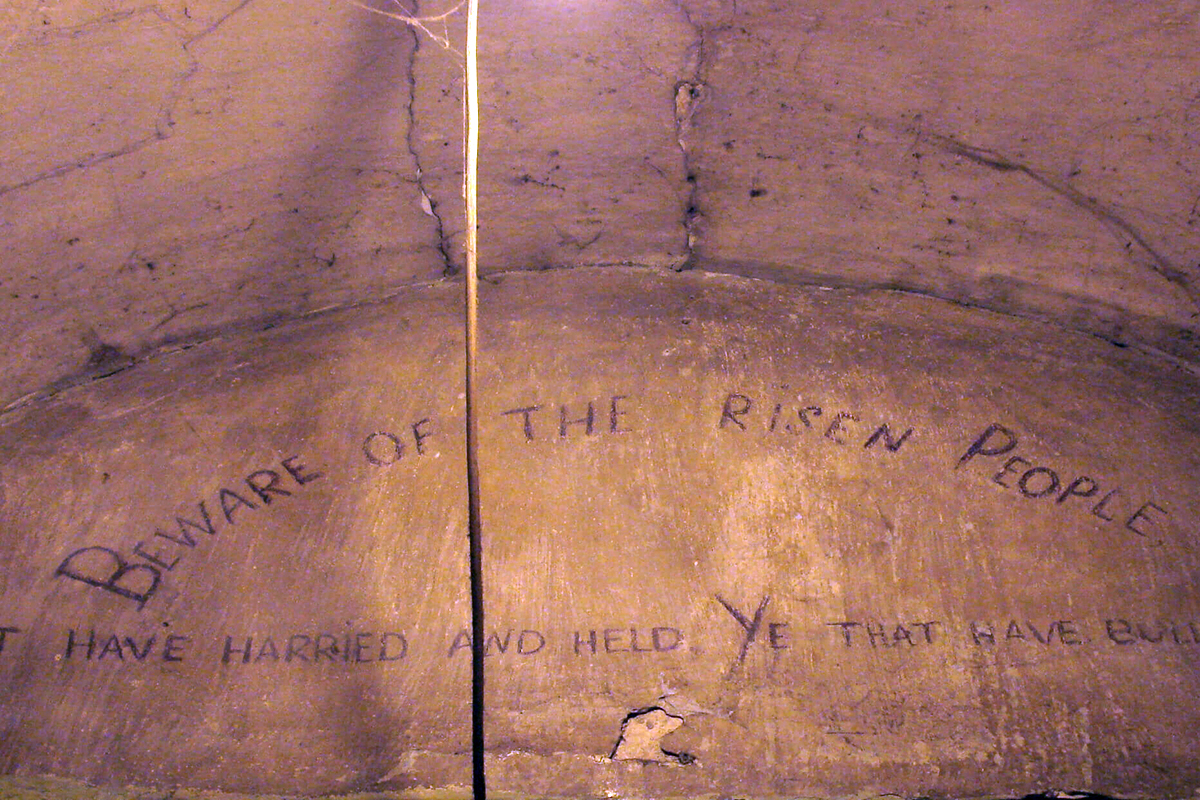
The Rising Sun
South Kilkenny Historical Society
Mullinavat, 20/5/2016
Talk delivered to the South Kilkenny Historical Society 2016
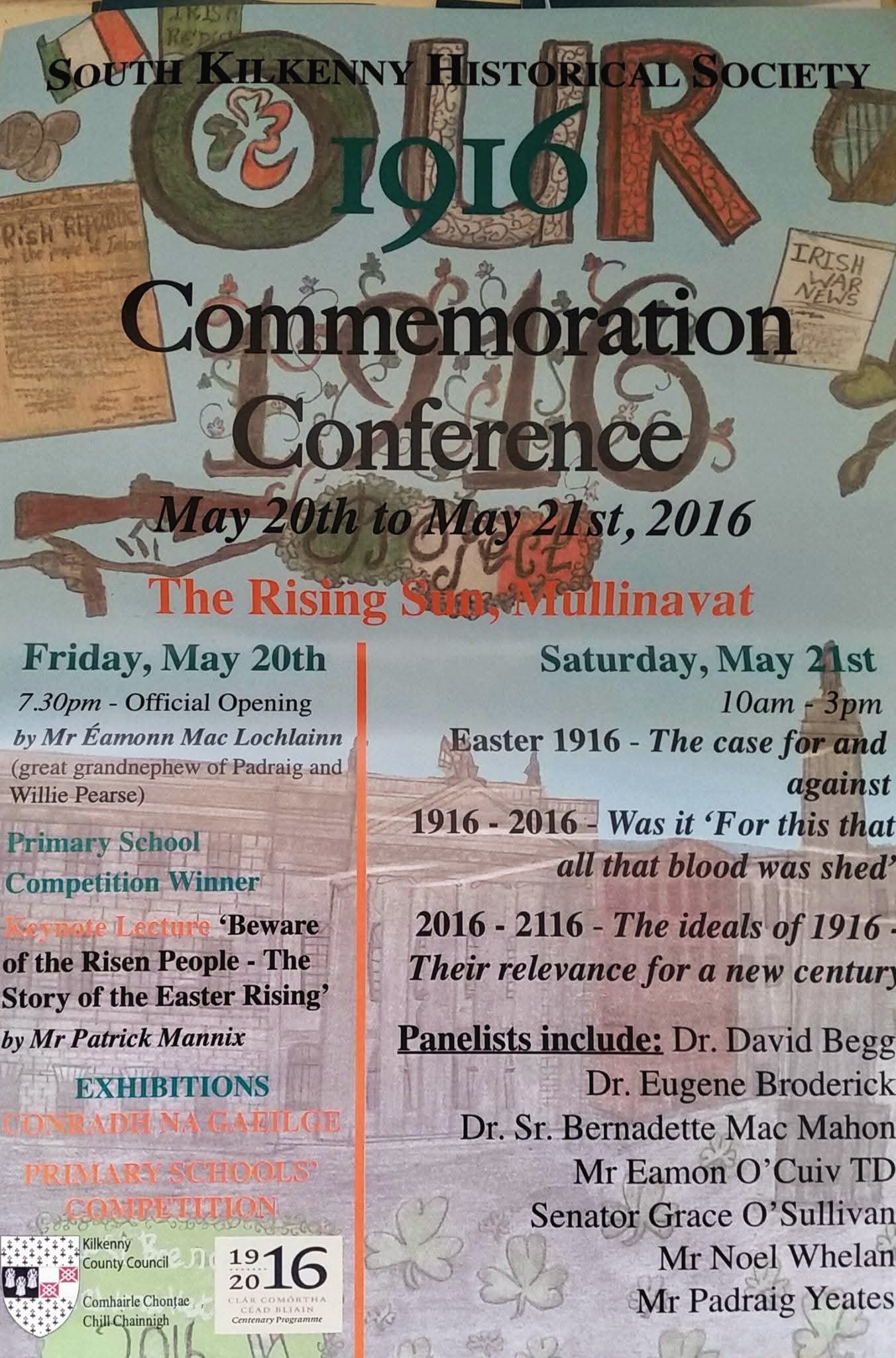
‘Beware of the risen people, that have harried and held ye, that have bullied and bribed’
So reads the graffiti over the archway that leads to the 1916 corridor in Dublin’s Kilmainham Gaol. Graffiti reputedly painted by prominent female Republican prisoner Dorothy MacArdle during the Civil War that still resonates today as much as it did in 1922. When MacArdle was painting these words in 1922 the Republic that she and so many other republicans had fought and died for looked further away from reality than ever. As she walked the corridors of Kilmainham Gaol in 1922 past the cells of the men and women of 1916 what were her thoughts and opinions of the new Irish Free State. She like so many others believed in the ideals of Pearse, Clarke and Connolly and felt betrayed by the signing of the Anglo-Irish treaty. This was not the Ireland that the men and women of 1916 had given their lives for and the next generation of revolutionaries looked further away of achieving this Republic now more than ever. Written almost 95 years ago, the graffiti that MacArdle etched into the stone walls of Ireland’s Bastille still survives and is a reminder to visitors today who pass under that archway of what the men and women of 1916 and later aspired to. MacArdle and her fellow republican prisoners were not alone in their determination to secure a sovereign independent republic. They were literally walking in the footsteps in Kilmainham Gaol of so many generations of Irishmen and women who had suffered greatly in trying to secure a free and independent Ireland. As Pearse and company detailed in the Proclamation
In every generation the Irish people have asserted their right to national freedom and sovereignty; six times during the past three hundred years they have asserted it in arms. Standing on that fundamental right and again asserting it in arms in the face of the world, we hereby proclaim the Irish Republic as a Sovereign Independent State. [1]
Tonight I’m going to detail what Ireland was like for the revolutionary generation of 1916. The Ireland they grew up in, the hopes and aspirations of the Easter Rising and the implications for Rising had on Ireland.
I’m going to begin with the story of Ireland in the late nineteenth century; a story of the two Irish communities, the rural and the urban. Common strands between both these communities were emigration, poverty and poor education. Prevalent firstly in the rural Irish community was the sense of isolation, the question of land ownership and poverty. Meanwhile in the urban Irish community the dominant worries of the ordinary man and woman included housing, quality of healthcare and employment. Despite all these issues in both communities and for all the centuries of unrest and rebellion against British rule in Ireland, Éire was still seen by many as the jewel in the crown of the British Empire and remained arduously loyal to the monarchy.
The largest urban community in Ireland, Dublin, the second city of the Empire, was a prime example of the complexities involved in Irish society in the late nineteenth early twentieth century.
Within the boundaries of the first city of nationalist Ireland there were great divisions in class and culture. This was a city of genuine diversity, its many complexities defying easy explanation. Rich and poor, immigrant and native, nationalist and unionist, Catholic, Protestant, Jew & Quaker, and so many more were all bound together in the life of the city. [2]
For all its diversity the capital city and centre of Britain administration in Ireland was struggling to breath under the shackles of British rule. The campaign for Home Rule was gathering momentum however the Irish political elite of the Irish Parliamentary Party were more concerned with a sample of power from Westminster than what was happening to the society around them at home. They turned a blind eye to the deterioration of their own capital.
Dublin had one of the most underfed, worst-housed, and badly paid populations in Europe. Twenty-one thousand families lived in single-room tenements. The death-rate at birth of 27.6 per 1,000 was higher than that of any other city in Europe (with Moscow second to Dublin). Pearse wrote in Irish Freedom (October 1913): I calculate that one-third of the people of Dublin are underfed; that half the children attending Irish primary schools are ill-nourished…I suppose there are 20,000 families in Dublin in whose domestic economy milk and butter are all but unknown; black tea and dry bread are their staple diet. [3]
As the social condition of Dublin deteriorated further the cracks were papered over by the arrival of none other than the royal family. The celebrity status of the royal family to the ordinary citizen meant that the city came to a standstill during the occasion of three official royal visits during the early twentieth century. On the last of these visits King George V wrote as he left Dublin Castle in 1911, ‘of his gratitude for the Irish people’s “spontaneous and hearty loyalty that has greatly touched our hearts” and looked forward to “coming amongst our Irish people again, and at no distant date”. [4]
The people of the capital were not the only ones to show their affections to the royals. On a private visit to Kilkenny Castle to stay with the Butler family in 1904 King Edward VII and Queen Alexandra were afforded another rapturous welcome by the local people of the city. To the royals the Ireland of the early nineteenth century contained loyal subjects who were both willing and grateful to accept British intervention in the ruling of their daily lives. The castle and the Butlers were symbolic of the ruling elite in Ireland at the time. Their extravagant and magnificent picture gallery was the backdrop to one of the largest anti-Home Rule meetings seen in Irish history. The meeting, attended by some 300 visitors, included speakers such as Lord Midleton; Lord Annaly; Lord Kenmare and Lord Desart. [5] The meeting showed how the elite Anglo-Irish across rural Ireland remained firmly loyal to the crown and were firmly opposed to the possible introduction of Home Rule. Although the advent of Home Rule may have brought marked improvement to the life of the ordinary rural land owner, the elite class resisted the introduction of Home Rule with great strength.
Land and land ownership has always had a major affect on the Irish psyche none more so than in the late nineteenth early twentieth century. This was the root of all worries of the rural community.
The land of Ireland was simply not sufficient to feed all those who were trying to get a living off it. This led to competition for land and drove up rents, thus reducing still further the people’s resources. Things could have been better if farming methods had improved, but, except in Ulster, most farmers had no security of tenure, and they had learnt by experience that if they improved their holdings, the landlord was quite likely to put up the rent. [6]
The rural farmer felt isolated from the bureaucrats in Westminster. Due to the lack of slow improvement in farming methods and the slow move towards the disintegration of the vast landlord estates emigration and poverty were a constant worry for the rural communities. Seamus Brennan details in a recent edition of the Old Kilkenny Review an interesting case in Kilkenny which sums up the urban/rural divide.
Both tendencies were exhibited in the evidence of Mr James Nolan, a prosperous Kilkenny farmer in 1881. His evidence to the Municipal Boundaries Commissioner was given in the context of the proposed revision and extension of the boundaries of Kilkenny City to include a large adjoining area. This would have led to an increase in the rates payable by the owners of lands and it would have been more profitable for Mr Nolan to remain outside the borough boundary. [7]
When questioned by the Commissioner the following exchange took place,
Do you think you get great advantages from the city? – Yes, and disadvantages, too. Everything is plundered and taken from you; everything is stolen, and you might as well live two miles out. It would be better to live three miles or more from Kilkenny than near it. [8]
Although the rural and urban communities were divided in many aspects of daily life there was a strong undercurrent of unrest constantly festering beneath the surface. Although the streets of both Kilkenny and Dublin were thronged with well wishers for the royal visits not everyone felt the same and made their objections known. Ardent nationalist and prominent revolutionary actress Maud Gonne ‘enraged neighbours by hanging out black petticoats from her Rathgar home — and barricaded herself in when the police called. [9] In Kilkenny during the royal visit fervent nationalists draped a black flag on the roof of one the houses of Black Mill Street, near Black Abbey, so as the royals would see this from their bedroom window in Kilkenny Castle. [10] This undercurrent was felt strongly by none other than the Irish Republican Brotherhood. They had waited secretly in the wings while the constitutional struggle for Irish independence failed.
When the Second Home Rule Bill (1893) was defeated by the House of Lords, the constitutional struggle was seen by many as a lost cause. The only other alternative was the Fenian solution, by means of an armed revolt. The new political nationalism offered a compromise between Home Rule and Fenianism, and appealed to people on both sides of the political divide. The one common bond shared by all was a desire to achieve Irish independence. The new nationalism was to become a major factor in the fight for independence, and provided most of the leadership and ideology for the 1916 Rising. [11]
The IRB in Ireland led by Thomas Clarke and supported by the American Fenians of Clann na nGael led by John Devoy attempted to infiltrate each strand of Irish society. Previous rebellions in Ireland had failed miserably due to informants and infiltration from British agents. However, Clarke and company made sure to keep their plans for a rebellion confined to a small bunch of handpicked revolutionaries. Anti-British sentiment was beginning to bubble under the surface with the postponement of Home Rule again in 1912. By this stage the IRB had ‘infiltrated the leadership of every Irish Ireland movement of consequence, including the Gaelic League, the GAA and many other bodies’. As Tim Pat Coogan contends
it may or may not have been an IRB man who prompted the vice-president of the Gaelic League, Professor Eoin MacNeill, to write a momentous article in the Gaelic League’s official organ, Claidheamh Solais, on the heels of the Ulster Volunteers’ gun-running. The article put forward the idea that if the Ulster Volunteer Force could arm and organise to defeat Home Rule, perhaps it was time for Nationalists to arm and organise themselves to prevent Home Rule being defeated by force. Shortly after the article appeared in October 1913, a meeting to which MacNeill was invited was held in Wynne’s Hotel, Dublin, at the instigation of the IRB. [12]
With Home Rule set to be implemented in Ireland by 1914 military bodies across the island were beginning to arm and drill preparing for an impending defence of their political allegiances. Ireland was headed down the path of civil war as by 1914 five armed armies were now present and battle ready on the island. These included the Irish Volunteers, the Ulster Volunteers, the Irish Citizen Army, the Royal Irish Constabulary and the regular British army. Home Rule was the spark that was going to ignite a bitter war in Ireland but it paled into significance once World War One broke out in July 1914. Both members of the National Volunteers and the Ulster Volunteers raced to the front not just to show their allegiance to the crown but for the National Volunteers encouraged by the promise of Home Rule at home once the war had ended. The war never ended before the leaves fell as many had predicted and as the bodies began to fill the battlefields of the Somme and Flanders the Volunteers who remained at home began to realise that ‘England’s demise was indeed Ireland’s opportunity’.
A military committee of the IRB, including Patrick Pearse, Joseph Plunkett and Éamonn Ceannt, had been formed to plan the rebellion. Clarke and MacDiarmada joined the committee in September 1915, and this became the new Supreme Council of the IRB. They held the positions of secretary and treasurer, and had Denis McCullogh, an IRB man living in Belfast, elected as chair. McCullogh’s distance from Dublin ensured that Clarke and MacDiarmada ‘effectively controlled the supreme council’. [13]
The British authorities were aware of murmurings of plans for a rebellion being put in place but never acted on their intelligence reports and indeed for the Easter Weekend of the Rising preceded to allow a substantial amount of leave to be taken by the regular army in Dublin. A large amount of soldiers spent Bank Holiday Easter Monday at Fairy house racecourse on the day of 24th April 1916, the exact day the Irish Republic was proclaimed. The British authorities were indeed caught by surprise but although the Volunteers had the element of surprise they failed to seize their advantages. The Rising is a story of miscommunication, poor planning and bad luck that was destined to failure. With the capture of Casement at McKenna’s fort in Co. Kerry, the scuttling of the Aud and 20,000 rifles followed by Eoin MacNeill’s countermanding order the morale amongst the military council was very low. On Easter Sunday 1916 it was decided to postpone the rising by twenty four hours to Easter Monday as Clarke and his cohorts were destined that it was now or never if they were to preserve the identity of the Irish people separate from the British Empire and monarchy.
Although a predominantly urban conflict it was fought by many rural men and women who had come to the capital to make a living. It was a unique event for many reasons. It was the first major urban conflict in modern European history as opposed to the trench warfare taking place at the Battle of the Somme. It also brought together people of various creeds, backgrounds and professions together with the same end goal that would not have in normal circumstances mixed with each other let alone shared the same political ideals. Their end goal, an Irish Republic was their unifying bond. Pearse saw this and realised that although the Rising was destined to failure a fire would be re-ignited in the hearts of the Irish people and their lives would not be in vain.
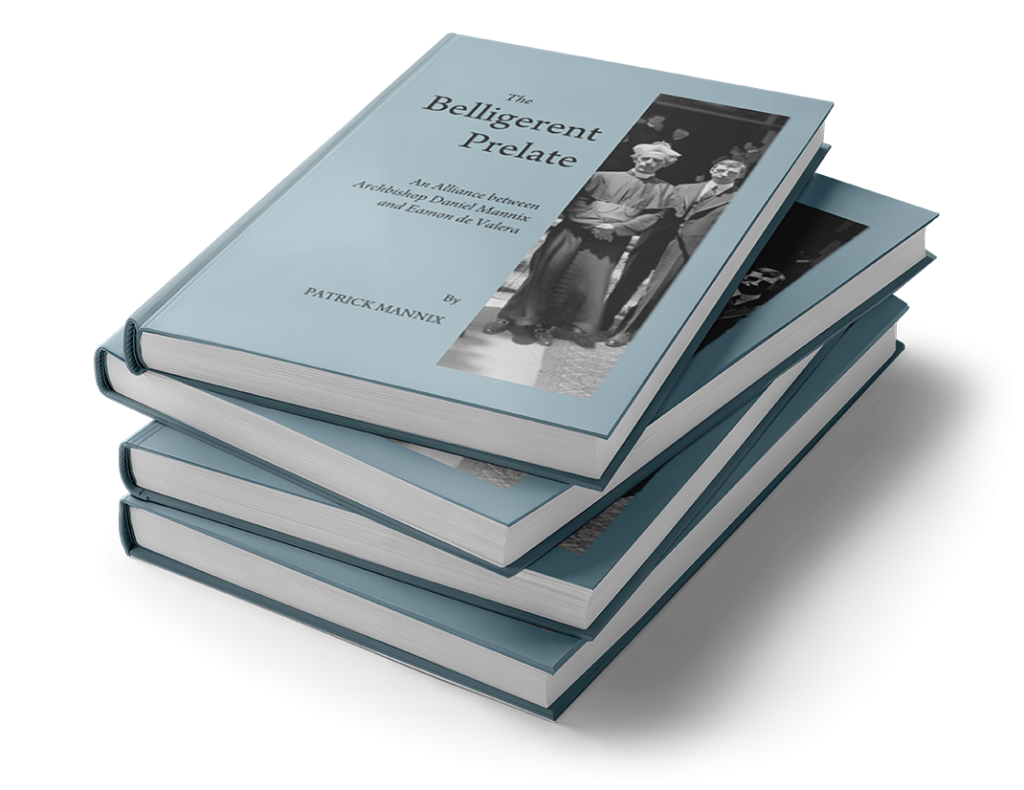
From the 3rd to the 12th of May, the blood of the leaders began to stain the ground of the Stonebreakers yard and the tears of the Irish communities began to flow around the world and their hearts began to harden against British Imperialism. The reaction of the Irish at home and abroad was swift and highly critical of the British reaction to the Rising. On the 30th of April in Melbourne, three days before the executions began, Corkman Archbishop Daniel Mannix, coadjutor Archbishop of Melbourne and former President of St. Patrick’s College Maynooth, lamented how the Rising was
The natural regrettable sequel and response to the campaign of armed resistance and civil war which the Carsonites had been allowed to preach and prepare for within the last few years…Mannix said that he was quite clear in his own mind that the British Government, by its failure to deal with the treason of the Carsonites, and by its shifty policy in regard to Home Rule has, unwittingly he supposed led to the result which we must all deplore. Before condemning the misguided leaders of this movement to be shot, they should remember that the leaders of another movement were taken into British Cabinet. [14]
Should they have given lifetime prison sentences to the leaders many ordinary citizens would not have cared! The Rising was highly unpopular in Dublin. The city was destroyed, innocent civilians and children had been killed – over 250 people killed with over 2,000 injured, vast looting had taken place; martial law was imposed making food even harder to come by in wartime. The relatives of those bravely fighting on the front for Home Rule felt betrayed by the leaders and were also afraid they would now lose their military service money, vital in a stagnant economy. However, the manner of the executions and the stories that would emerge of Patrick and his brother Willie, Joseph and Grace and James Connolly among others would change public opinion. The memories of rebellions past fought and lost, of prophetic words ushered by Tone and Emmet now came to the fore and a new breed of martyr instilled a belief in the ordinary Irish person. If these group of rebels only 1,600 strong could bring the attention of an Empire and the world on the cause of Irish independence what would happen if they planned and implemented a proper resistance strategy. Sinn Féin would recognise this opportunity and through their campaign against conscription and later their policy of abstentionism they rode the tide of popularity after the rising to bring the British establishment to the roundtable of discussion.
Within a few months, public opinion had swung against London so much that the prisoners became more of an embarrassment in jail than at liberty, and by Christmas many were set free, Michael Collins and Eamon de Valera among them. Collins set about building up both Sinn Féin and the IRB. One of Collin’s initiatives was to put up a prisoner, Joseph McGuinness, as a candidate in a by-election in Longford. The poster showed a man in prison garb with the wording: ‘Put him in to get him out. [15]
The British policy of internment of volunteers to Frongoch, Wales only pushed the urban rural divide together to form universities of revolution. ‘In the immediate period after the Rising 3,430 men and 79 women suspected of being ‘Sinn Féiners were taken into custody’. [16] There was no division now, male or female, rich or poor, educated/uneducated, teacher/lawyer all joined ranks and a united front was created to tackle British rule in Ireland and once again make Ireland free.
By the time of the general election in December 1918, the country had moved unmistakably towards Sinn Féin. Sinn Féin won seventy-three seats, the unionists twenty-six, and the parliamentary party a mere six. The defeat of the parliamentary party took place in circumstances extremely unfavourable to them. They had been geared to constitutionalism and in fact committed to it under Redmond. Essentially they were a peacetime party, but Ireland in 1918, and possibly since 1912, could hardly be described as at peace. [17]
The British military establishment showed no mercy in 1916 and acted swiftly and decisively to punish those who organised and implemented this rebellion. As General Maxwell said to John Dillion
I am going to ensure that there will be no treason whispered – even whispered – for a hundred years. He believed that the execution squads would fire the last shots of the 1916 Rising. But he was wrong.’ As Clarke, MacDermott but particularly Pearse hoped, General Maxwell’s guns would fire the first shots in the war of independence. [18]
As Pearse lamented in his final poem before his execution.
And I say to my people’s masters: Beware
Beware of the thing that is coming, beware of the risen people
Who shall take what ye would not give.
Did ye think to conquer the people, or that law is stronger than life,
And than men’s desire to be free?
We will try it out with you ye that have harried and held,
Ye that have bullied and bribed.
Tyrants… hypocrites… liars! [19]
[1] Irish Proclamation.
[2] http://www.census.nationalarchives.ie/exhibition/dublin/main.html accessed 16/5/2016, ‘What was Dublin like in the early 20th Century.
[3] Donal McCartney, ‘From Parnell to Pearse: 1891-1921’ in The Course of Irish History (Cork, 2011), pp 262-263.
[4] Gordon Rayner, ‘How George V was received in Ireland in 1911’, http://www.telegraph.co.uk/news/uknews/theroyalfamily/8121389/How-George-V-was-received-by-the-Irish-in-1911.html accessed 18/05/16.
[5] Butler Journal
[6] J. H Whyte, ‘The Age of Daniel O’Connell: 1800-47’ in The Course of Irish History (Cork, 2011), p. 216.
[7] Seamus Brennan, ‘Kilkenny in 1881, Opposition to proposals to extend the boundaries of Kilkenny City – The Strong farmer who preferred to be three miles away from Kilkenny, to save tax’ in Old Kilkenny Review 66, 2014, pp 67-68.
[8] Ibid.
[9] Lorna Hogg, ‘The day the British king arrived drunk for his grand tour of Dublin’, http://www.independent.ie/lifestyle/the-day-the-british-king-arrived-drunk-for-his-grand-tour-of-dublin-26706121.html accessed 18/05/16.
[10]
[11] Mark Tierney, ‘The New Nationalism Part II – Political and Social Nationalism’ in Ireland Since 1870, p. 131.
[12] Tim Pat Coogan, 1916: The Easter Rising, (London, 2001), p. 50.
[13] Anne-Marie Ryan, 16 Dead Men: The Easter Rising Executions, (Cork, 2014), pp 51-52.
[14] Patrick Mannix, The Belligerent Prelate: An alliance between Archbishop Daniel Mannix and Eamon de Valera, (Newcastle-upon-Tyne, 2013), pp 58-59.
[15] Tim Pat Coogan, 1916: The Easter Rising, (London, 2001), p. 171.
[16] Shane Hegarty and Fintan O’Toole, The Irish Times Book of the 1916 Rising, (Dublin, 2006), p. 171.
[17] Donal McCartney, ‘From Parnell to Pearse: 1891-1921’ in The Course of Irish History (Cork, 2011), p 269.
[18] Gene Kerrigan, The Scrap, (Dublin, 2015), p. 259.
[19] The Rebel by Patrick Pearse