Baying for blood: The assassination attempt on the First Duke of Ormonde
This article will provide a chronological account of the most audacious assassination attempt in seventeenth century Britain, the attempt on the life of the First Duke Ormonde, James Butler.
Baying for Blood:
The assassination Attempt on the First Duke of Ormonde
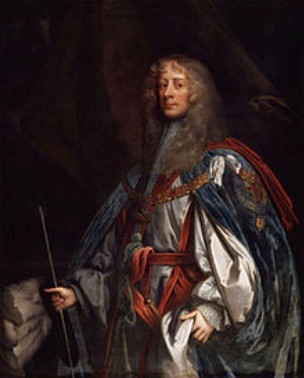
1st Duke of Ormonde, James Butler (1610-1688)
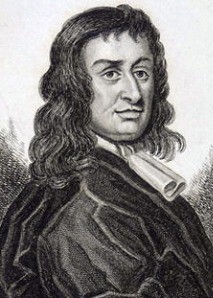
‘A Notorious Rascal’ reads the article from The Lewis Daily Sun. Although dead some two hundred and thirty years by the time the article was published, Colonel Thomas Blood was still able to grab the headlines. According to the article written in 1908, Blood was ‘a daring, fearless scamp and one of the most reckless and brazen soldiers of fortune that ever cut a swath in England’.[1] Blood has long sealed his place in the pantheon of British historiography due to his plot to steal the British Crown Jewels in 1671. His place in Irish history however, is largely intertwined with that of the first Duke of Ormonde James Butler.
Blood’s exploits were most certainly that of a soldier of fortune, adventurous; daring; controversial and most definitely grabbed the public imagination. He was once described by Lord Arlington as ‘the father of all treasons, misprisions of treason, murders, homicides, felonyes, assaults, batteryes, and other offences’.[2] He was the complete antithesis or anti-hero to James Butler who strode like a colossus through seventeenth century Ireland and whose legacy can still be seen far beyond the walls of his ancestral home, Kilkenny Castle. James Butler had much to contend with during his long life none more so than Oliver Cromwell himself but Colonel Thomas Blood was always lurking in the shadows waiting for his opportunity to strike down the great Anglo-Irish statesman and soldier. This article will provide a chronological account of the most audacious assassination attempt in seventeenth century Britain, the attempt on the life of the First Duke Ormonde, James Butler. This will be achieved through the analysis of both historical and contemporary primary and secondary sources. I will then surmise the impact Colonel Thomas Blood had on the life of James Butler and his legacy on Irish and British historiography.
Few in seventeenth century Irish and English history can compare to the exemplary statesman and soldier that was the Duke of Ormonde. A man of integrity and action, some of the praise delivered on the pages of history include “a person of the most ancient honor, and of singular affection to the crown,” who “kept his loyalty untainted,” commended as “a man of distinguished integrity, patience, activity and talent,” a man “crown’d with honor and years”. His curriculum vitae reads commendably as defending his King Charles I, subsequently suffering exile with Charles II., defiance of Cromwell, four times holding the high office of viceroy of Ireland, and preserving his lofty spirit unbroken amid the intrigues of the licentious courtiers of the Restoration’.[3]
Thomas Blood’s story like James Butler begins in the early seventeenth century. He was born in 1618, eight years the junior of James Butler, into a well established Protestant family who had sizeable lands in counties Clare, Meath and Wicklow. The place of birth is disputed between counties Clare and Meath however, it is documented that his family held significant status in seventeenth century Irish society. It is recorded that in 1613, five years before Thomas’s birth, Edmund Blood, Thomas’s grandfather, was one of twelve men appointed as free burgesses of Ennis, County Clare. This privilege allowed Edmund Blood the honour of ‘voting for the two members of Parliament who would represent the town in Dublin’.[4] His father, an ironmonger, lived in Sarney in County Meath and Thomas would later inherit these lands from his father. Of the little details we know of his youth it was said that ‘his birth was such as gave him those advantages that usually distinguish a man from the Vulgar’ and the education he received was ‘strict and sober’.[5] It did not take long for Blood to figure out that it was a military career he longed for. After his marriage at the age of thirty to a Miss Holcroft of Lancashire in England where he spent a lot of his early life he decided to pursue a career in the army. It was a volatile and hostile period in British and Irish history and military entrepreneurs could fast make a name for themselves. Blood fought on both sides during the English Civil War and was described by cavalry commander Prince Rupert as a “very stout bold fellow”. Since his family were committed Protestants with sizable holdings in Ireland it is not surprising that he fought on the Royalist side with the outbreak of the Roman Catholic rebellion in Ireland. The uneasy alliance forged by James Butler, head of the Royalist armies in Ireland and the Confederate Catholics would not have gone down well with staunch Protestants such as the Blood’s. Subsequently Thomas and his father, of the same name, left Ireland and switched their allegiance from King to Parliament fighting under Cromwell himself.[6] His services as a lieutenant in the parliamentary army gained him notoriety and fortune. In acknowledgement for his services to the army, Oliver Cromwell awarded him grants of land in Ireland in 1653 as payment for his services while also ironically appointing him as Justice of the peace.[7]
However, the rapid shifting of the sands on the British political landscape would mean that following Cromwell’s death in 1658, Britain would quickly return to the monarchy for stability. Not for the first time in his life, Thomas Blood would find himself on the wrong side in the annals of history. Following the coronation of Prince Charles II as King of England in 1660, the new King or Merry Monarch as he was known, set about pursuing those who had, not only fought with Cromwell, but more importantly were complicit in supporting the beheading of his father, King Charles I some ten years previous. Although amnesty was granted to Cromwell’s supporters through acts of parliament, 50 people were specifically excluded from these acts and covert revenge was taken on others. Various dissenters were removed from office for life and confiscation of lands took place through the Act of Settlement from many of Cromwell’s parliamentary officers including Colonel Thomas Blood.[8] Meanwhile those who had remained loyal to the crown and who gambled correctly were to be rewarded kindly for their service and the person who would stand to gain the most from this loyalty was James Butler. The full list of honours awarded to James is quite extensive but most important were his appointments as commissioner for the treasury and the navy, Lord Steward of the Household, Lord Lieutenant of Ireland and the one we all remember him for as Duke.[9] James Butler’s appointment as the first Duke of Ormonde in March 1661 confirmed the Butler’s status as one of the most powerful Anglo-Irish families in Irish history but also cemented the Duke’s status within the hierarchy of the British court making him some very powerful enemies.
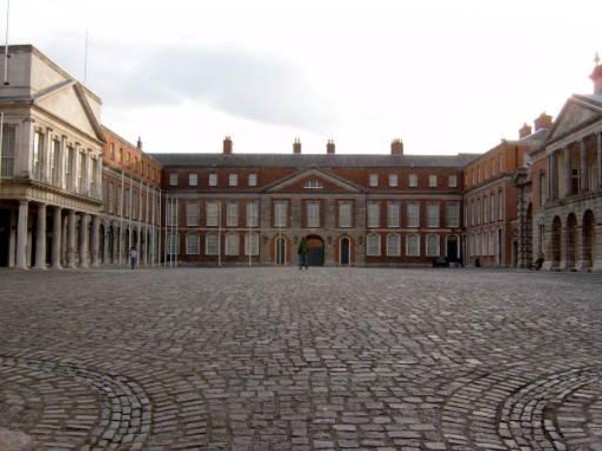
Ormonde was de facto responsible for Irish activities under the crown and set about repairing the damage done during the English Civil War in Ireland. Mass displacement of land and property created a hostile scenario between the Cromwellian Planters and the royalist supporters of the monarchy. By now, dispossessed of his lands Blood had taken up residence in Dublin with his brother-in-law Lackie, or Lecky a Presbyterian clergyman. He next appears on the footnotes in Irish history in June 1663. According to Abbott, one the early biographers on Blood, ‘a Dublin butcher, Dolman by name, is found petitioning the Duke of Ormond for the return of an “outlandish bull and cow” of which he had been unlawfully deprived by Thomas Blood, lieutenant in the late army’.[10] The footnote appears mundane however, Blood is now in the Irish capital and in close proximity to the Duke and as Abbott continues, ‘the gallant lieutenant was in far deeper designs than the benevolent assimilation of other people’s outlandish bulls, and before the worthy butcher petitioned against him he had come under the direct attention of the Lord-Lieutenant in a more serious connection’.[11] Although Kilkenny Castle was the primary ancestral residence of the Butler family the Lord-Lieutenant of Ireland up until the late eighteenth century resided in the Vice regal Apartments in Dublin Castle.
Vice Regal Apartments, Dublin Castle
It was here at the centre of British administration in Ireland that the paths of these two personalities of seventeenth century history would first cross.
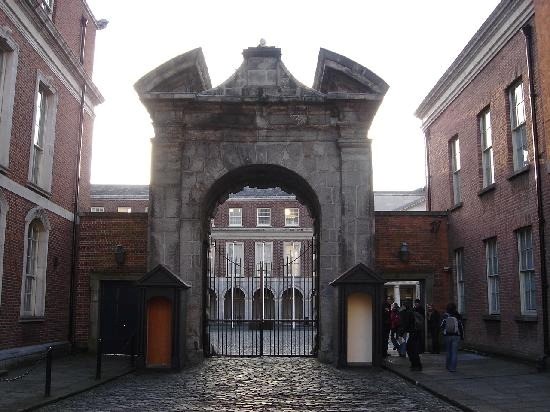
The castle and Ormonde were the central symbols of the monarchy in Ireland therefore seizing both would make a huge statement of intent to the King. In what has become known as the ‘Blood Plot’, as it is believed that Thomas Blood was the ringleader, in 1663 a radical group of Protestant nonconformists attempted to seize both Dublin Castle and the Duke of Ormonde. Their demands were concurrent with attitudes of the loyal Cromwellian who had suffered as part of the reinstatement of the monarchy. In defence of their land and religion the demands were that ‘all English would be restored to the land they held at the end of the Cromwellian era, that all soldiers involved would have the arrears owed to them paid in full at once, that the Solemn League and Covenant would be enforced and that, as they stated it themselves, ‘no popery would be tolerated’.[12] Like so many great historical plots human conscience was the downfall in this particular episode also. It was part of the duty of the Lord-Lieutenant to receive petitions in person. With such open access to the Duke it was proposed by Blood and his co-conspirators to blend in with these proceedings and strike at the opportune moment. Some eighty rebels, disguised as working men and loiterers, were to station themselves outside the main gate of the castle.
Dublin Castle Main Gate
One conspirator disguised as a baker, and carrying a basket of bread on his head, was to enter the gate, as if on his way to the kitchen. ‘As he went in he was to stumble and let fall his pile of loaves. It was assumed the guard would possibly rush out to catch some bread. The co-conspirators at the gate would gather as a diversion around the scene, rush the gate, seize the guard-house and its arms, overpower the guard, and, with the aid of the petitioners within, occupy the castle and seize Ormonde.[13] As Abbott states ‘the plot, in fact, wanted but one thing to succeed – secrecy. This it was not destined to have’.[14] An informer by the name of Philip Alden, a former Cromwellian who was a lawyer and dealer in forfeited estates, had felt the weight of guilt on being associated with this plot. He proceeded to inform on his co conspirators to his employer, Colonel Edward Vernon, who then brought him before the Duke to tell the whole story. The game was up and although escaping with a price on his head, Blood’s brother-in-law, Lackie, was captured and executed in spite of an effort on Blood’s part to release him. Blood managed to evade capture due to his mastery of many guises including dressing as a Quaker and a priest eventually making his way to Holland scheming for his next plot.[16]
Recent studies have supported the notion that Blood may have been acting as a spy on behalf of the government during his life. Even early biographers including Abbott have contended that ‘it is a remarkable fact that no small number of those who to all appearances were most deeply implicated in conspiracy, corresponded at one time or another with the administration, in many instances furnishing information of each other to the secretaries’.[17] Robert Hutchinson who has written extensively on Tudor history contended last month in BBC History Magazine that
‘the colonel became a spy for the king, eavesdropping on the whispers and gossip within the feverish atmosphere at court – and worked as a double agent in the dark, stinking alleyways of London, regularly informing on those conspiring to kill Charles and return England to the austere, God-fearing republic it was under Cromwell’.[18]
The court of England under Charles II was full of secrecy, conceit and concealment. Each subject was vying for the King’s favour and willing to do anything to achieve it. One such royal subject was George Villiers, 2nd Duke of Buckingham and reportedly one of the King’s wealthiest subjects. According to Hutchinson Villiers ‘hated Ormonde “mortally” and their feuds at court were often violent.[19] Buckingham had been a royal favourite of King Charles I and had even been raised by the King with his sons Charles and James following his father’s assassination. He had spent time like James Butler in exile in France with Prince Charles and following the Restoration of the monarchy acquired considerable political status within the court of the new King. Villiers would soon fall out of favour in court due to his extra-martial affair with Lady Shrewsbury and would soon become the main opposition to the Lord Chancellor Edward Hyde, Earl of Clarendon. His behaviour and belligerence would earn him a stint behind bars where he had plenty of time to plot the downfall of Clarendon and his great ally James Butler.[20] Along with Clarendon, and the Treasurer, Southampton, James Butler completed a triumvirate which dominated English public life following the restoration of the monarch. In 1667 however, the Realpolitik of English politics began to test Ormonde’s character and loyalty to the crown. The triumvirate was no more as by now Southampton had died, Clarendon was impeached and Ormonde was left to fend for himself against the pack of circling wolves. Losing his main power base and with the new administration known as the CABAL not seeing eye to eye with the 1st Duke, the sword of Damocles was beginning to hang precariously over the 1st Duke.
His cool relationship with the Villiers not only extended to George Villiers but also to Barbara Villiers the King’s formidable mistress. Historian David Hanrahan sets the scene
‘Ms Villiers had her heart set on owing the Phoenix Park and House near Dublin and had managed to obtain a warrant for the grant of the same from the King. But Ormonde had other plans for the place. Since Dublin Castle was in poor repair he wanted to enlarge the park and use the house as a residence for himself and his successors. Consequently, when it came before him, he refused to pass Barbara’s warrant and instead pushed ahead to fulfil his own plans. This enraged Barbara and when she next came upon Ormonde at court in England “she fell upon him with a torrent of abusive language…and told him…that she hoped to see him hanged”.[21]
Ormonde’s refusal of Villiers request showed his status in English politics that he was able to stand up to the King’s mistress and even more daring was his reputed response to Ms. Villiers abuse stating ‘he was not in much haste to put an end to her days, for all he wished with regard to her was, that he might live to see her old’.[22] The wolves were circling looking for weakness from Ormonde until it was time to attack and the weapon of choice was a man already familiar to Ormonde, Colonel Thomas Blood.
King Charles II has a reputation in English historiography as the ‘Merry Monarch’ as during his tenure many parties and lavish occasions were quite common. It is at one such occasion that our assassination attempt takes place. On the 6th December, 1670 a feast had been prepared for the Prince of Orange in the Guildhall in London to welcome him on his first official visit to England. As Lord High Steward of His Majesty’s Household, Ormonde had been chosen on this occasion to accompany the Prince of Orange to the feast. By now in his sixtieth year Ormonde preferred to retire early and let the festivities continue unabated and made his way back home to his residence in a mansion opposite St. James’s palace still known today as Clarendon House.[23] Thomas Blood had disappeared from the English public eye for over three years since his daring rescue of Captain Mason in 1667 but by 1670 he had returned to London living near the Tower of London at Aldgate. Still aggrieved at having lost his Irish properties under Ormonde’s rule in Ireland and following the execution of his brother in law following the ‘Blood Plot’, Blood had plenty of reasons to want the Duke dead. It has never been historically proven but it is commonly accepted that the Duke of Buckingham in no small part sponsored Blood and his assassination attempt on the 1st Duke of Ormonde.[24] The Villiers relationship with the Butlers had soured and the Duke was the main irk of their distaste. The day and venue was chosen and the plan was set into motion.
It would have seemed highly implausible in the late seventeenth century that the Duke of Ormonde and the serving Lord High Steward would be attacked on the streets of London but with Thomas Blood anything was possible. Security was not at the top of the Duke’s list as he would often, instead of blending in with the standard transport, travel in a great coach worthy of his status and wealth making him instantly recognisable. His carriage had spikes fitted to its frame to prevent the footmen or torch-bearers from climbing on.[25] Eyewitness reports from two barmen at the Bull Head Tavern in Charing Cross give us a better insight into the plot.
‘Between six and seven o’clock on the evening in question they remembered five men entering the premises. The eyewitnesses Wilson and Pretty stated that they did not know the five men who arrived that evening on horses and carrying swords. The men ordered six pints of wine, two pints each of ‘canary, sherry and white wine’. Two of them were described as young men about twenty-six years of age, and the other three as middle-aged. At around seven o’clock both witnesses heard the shout “Make way here for the Duke of Ormonde!” which came from out on the street, and afterwards they saw the Duke’s coach pass by. Shortly after this the men paid their wine bill, purchased three pipes of tobacco and were seen riding off at a “good pace” towards the Hay Market or Pall Mall’. [26]
The five assailants were on their way to intercept the Duke and his carriage as it passed through St. James’s Street on the way to Clarendon House. The assassins overpowered the Duke and his entourage. Blood, and his son-in-law, Thomas Hunt, took the Duke from his coach and proceeded with the next part of the plan. But as James Clark, one of the Duke’s household staff, describes, their plan didn’t play out as they thought.
‘We hastened off in the direction indicated by the coachman who had been overpowered. They found no one at the place where the attack had been made, but hurrying on past Devonshire House they came upon two men struggling in the mud of the Knightsbridge road. As they approached, one of the combatants, a man of huge stature, struggled to his feet. He was immediately joined by another who appeared from the shadows, and both fired their pistols at the prostrate figure. Then, without waiting to see the result, the ruffians mounted their horses which had meanwhile been held by a third man, and rode off. The rescuers, joined by many persons whom their alarm had brought together, hurried to the man in the road. He was far too spent for words and in the darkness was unrecognisable from dirt and wounds. It was only by feeling the great star of the order of the Garter on his breast that they identified him as the Duke’. [27]
Although senior in years compared to his attackers the strength, intelligence and riding skills of the Duke no doubt saved his life. Ormonde, a distinguished horseman, had managed to force himself and his assailant, whom he was tied to, off the horse they were travelling on and onto the roadside. This was only feasible as Thomas Blood had already rode ahead to Tyburn to prepare the rope where he had intended to take the Duke and hang him on the common gibbet. This was not a political abduction looking at blackmailing the Duke and his peers but most definitely a political assassination. This conclusion can not only be drawn from the preparation of the gibbet by Blood but also the use of revolvers on the Duke which failed due to the poor visibility on the night. News of the attempt spread fast and an account of the assassination attempt along with a Royal Proclamation offering a reward of one thousand pounds were also issued but Blood and his group of assassins escaped. [28]
A House of Lords Committee of sixty-nine was established the following month to further investigate the assassination attempt. After the deliberation of evidence including witness testimony ‘the three prime suspects were identified as Dr Thomas Allen (alias for Thomas Blood), Mr Thomas Hunt and Mr Richard Halliwell. Apart from the three main conspirators, the names of those who were thought to have aided and abetted in the plan included Samuel Holmes, John Hurst, John Washwhite, Thomas Dixey, William More and a Fifth Monarchist called William Smith’. James Butler presented his version of events before the committee a month later along with his coachman Henley, footman Exby and his porter Brooks. As Hanrahan notes ‘in all, over fifty witnesses were questioned during the investigation and a wealth of documents examined but in the end no sufficient evidence was found to prosecute any of the minor figures. The Committee reported on 17th February and subsequently a bill was drawn up against three men, Blood, Blood Junior and Halliwell. A certain amount of time was allowed for the suspects to surrender themselves voluntarily, but needless to say they never did and Blood now joined the ranks of the most wanted men in Britain’.[29] He would later himself write to the Duke of Ormonde saying ‘the greatness of my crimes so far exceeds expression, that were not my burdened soul encouraged by finding vent to its grief, though by such an acknowledgement as bears little proportion to my guilt, I had forborne this further trouble to your Grace’.[30] Buckingham it was felt was still associated with the plot but like the junior assassins it could never be proven. This did not deter Ormonde’s son Lord Ossory from pointing the finger at the Duke. Upon seeing the Duke ‘standing by the King at court, he became red-faced with anger, and told him: “My Lord, I know well that you are at the bottom of this late attempt of Blood’s upon my father. Therefore I give you fair warning that if my father comes to a violent end by sword or pistol; if he dies by the hand of a ruffian, or by the more secret way of poison…I shall consider you the assassin. Wherever I meet you, I shall pistol you, though you might stand behind the king’s chair’.[31]
Unfazed and undaunted by the failure of his assassination attempt Blood proceeded to live his life in London and plotted an even more audacious attempt that has sealed his place in British historiography. He proposed a daring and outlandish attempt at stealing the very symbol of the British monarchy – the Crown Jewels. Acting as an interested visitor to the Tower of London with an actor playing his wife, suddenly and deliberately Ms. Blood felt faint and was assisted by Mr Talbot Edwards (the keeper of the Jewels) with some refreshment and care. Building up a false rapport, Blood delivered a few days later a gift for the keeper’s wife in return for his kindness. Spotting an opportunity, Blood proposed a marriage between a supposed daughter of his and the son of Edwards. They struck up an acquaintance and Blood used this to ask the keeper if he would allow some friends of his to see the Jewels before they departed London early in the morning. The night was the 9th May 1671 and Blood with his accomplices upon invitation into the keeper’s office proceeded with the plan disabling the keeper and removing the jewels from storage. They would have made away with the most prized assets in the land only for Edwards managed to free himself from captivity and raised the alarm. The game was up for Blood and his accomplices and it looked like his race was won but as is synonymous with the infamous Clare man there were still a few twists along the way.[32] In true dramatic style with certain death imminent Blood refused to co-operate with the authorities demanding an audience with none other than the King himself. Blood was taken to the Palace where he was questioned by the court including King Charles, Prince Rupert, The Duke of York and other members of the royal family.
King Charles was amused at Blood’s audacity when Blood told him that the Crown Jewels were not worth the £100,000 they were valued at, but only £6,000! The King asked Blood “What if I should give you your life?” and Blood replied humbly, “I would endeavour to deserve it, Sire!” Blood was not only pardoned, to the disgust of Lord Ormonde, but was given Irish lands worth £500 a year! Blood became a familiar figure around London and made frequent appearances at Court.[33]
Blood extended his life by a further unexpected nine years, dying in 1680 in Bowling Alley, Westminster. His body was buried in the churchyard of St Margaret’s Church (now Christchurch Gardens) near St. James’s Park. Such was his reputation in life as in death his body was exhumed by the authorities for confirmation: such was his reputation for trickery; it was suspected he might have faked his death and funeral to avoid paying his debt to Buckingham who he had fallen out with over defamation of his character.[34]
Blood’s legacy in Irish historiography is merely as a footnote but he guaranteed his name in the indices’ of seventeenth century textbooks on British history with his audacious attempt at stealing the crown jewels. He was very much a product of the realm of seventeenth century British court. His skills and audacity made him a very valuable agent for hire. John Evelyn wrote after meeting the colonel shortly after his pardon ‘how he could never comprehend how Blood ever came to be pardoned and ever received into favour, not only after this but several other exploits almost as daring’. Hutchinson notes that ‘Evelyn was unaware that Blood was on the payroll of Charles II’s government as a spy and agent, willing to undertake the more disreputable but necessary tasks that the administration could afterwards cheerfully deny any involvement with. The king, always short of money, could even have employed Blood to steal his own crown jewels. Joseph Williamson, operational head of Charles II’s shadowy secret service claimed that the agent was worth “10 times the value of the crown”.[35] Another plausible reason for the pardon is that should Blood have been executed he might have informed on his possible sponsors including Buckingham. He would have exposed not just Villiers activities but also the activities of his cousin Barbara in a public fashion that would not just discredit the Duke of Buckingham but the King himself. The biggest loser in all of this political brinkmanship was James Butler, Duke of Ormonde. For the first time in his long distinguished career he looked vulnerable after the assassination attempt and his slow withdrawal from public office began to accelerate until his death in 1680. Buckingham’s constant political interference would ultimately strip Ormonde of the Lord Lieutenancy of Ireland and although later regaining the post, his status in the court of Britain had been damaged. The public manner in which Blood was given favour by the King showed also how Ormonde’s influence had waned in court and must have shown him where the powerbrokers were in the British court. Colonel Thomas Blood was the ultimate seventeenth century charlatan and his epitaph surmises the man in life as in death.
[2] Thomas Blood’s pardon as listed in the records of Lord Arlington, Secretary of State, 1 August 1671 (SP 44/34/110) http://www.nationalarchives.gov.uk/education/resources/the-king-the-crown-the-colonel/source-3/ accessed 5/8/15.
[3] The Book in London by Henry Shelley, Boston Evening Transcript 27 April 1912, https://news.google.com/newspapers?nid=2249&dat=19120427&id=Q4UAAAAIBAJ&sjid=G1oMAAAAIBAJ&pg=4751,5516292&hl=en accessed 5/8/15.
[4] David C. Hanrahan, Colonel Blood: The Man who stole the Crown Jewels, (Gloucestershire, 2004), p.2.
[5] Signed R.H., Remarks on the Life and Death of the famed Mr Blood, (London, 1680), p.2.
[6] David C. Hanrahan, Colonel Blood: The Man who stole the Crown Jewels, (Gloucestershire, 2004), pp.10-13.
[7] Robert Hutchinson, ‘The strange escape of Colonel Thomas Blood’, BBC History Magazine, p. 44.
[8] http://www.clarelibrary.ie/eolas/coclare/people/blood.htm accessed on 15/8/2015.
[9] Thomas Carte, The Life of James, Duke of Ormond: containing an account of the most remarkable affairs of his time, and particularly of Ireland under his government; with appendix and a collection of letters, serving to verify the most material facts in the said history (in 3 volumes) (Oxford, 1851), pp 7-17.
[10] Wilbur Cortez Abbott, Colonel Thomas Blood, Crown Stealer, 1618-1680, (London, _), p. 42.
[11] Ibid.
[12] David C. Hanrahan, Colonel Blood: The Man who stole the Crown Jewels, (Gloucestershire, 2004), p.30.
[13] Wilbur Cortez Abbott, Colonel Thomas Blood, Crown Stealer, 1618-1680, (London, _), p. 44.
[14] Ibid.
[15] Ibid, pp 30-31.
[16] http://www.clarelibrary.ie/eolas/coclare/people/blood.htm accessed on 15/8/2015.
[17] Wilbur Cortez Abbott, Colonel Thomas Blood, Crown Stealer, 1618-1680, (London, _), p. 55.
[18] Robert Hutchinson, ‘The strange escape of Colonel Thomas Blood’, BBC History Magazine, p. 44.
[24] Hutchinson, ‘The strange escape of Colonel Thomas Blood’, BBC History Magazine, p. 45.
[25] Hanrahan, Colonel Blood, p. 71.
[26] Ibid.
[27] Abbott, Colonel Thomas Blood, pp 14-15.
[28] J. Caulfield, ‘Portraits, memoirs, and characters of remarkable persons, from the reign of King Edward the third, to the revolution, etc’
http://www.dolmetsch.com/thomasblood.htm accessed on 21/8/2015.
[29] Hanrahan, Colonel Blood, pp 81-82.
[30] Thomas Blood to Ormond, [undated, 1670], Oxford University: Bodleian Library, Special Collections, MS Carte 69, fol(s). 164.
[31] Hutchinson, ‘The strange escape of Colonel Thomas Blood’, BBC History Magazine, p. 45.
[32] The Lewiston Daily Sun, ‘A Notorious Rascal’, May 13, 1908. p. 8. https://news.google.com/newspapers?nid=1928&dat=19080512&id=6rkgAAAAIBAJ&sjid=YWkFAAAAIBAJ&pg=1293,5454480&hl=en accessed 24/08/15.
[33] The theft of the Crown Jewels http://www.historic-uk.com/HistoryUK/HistoryofEngland/The-Theft-of-the-Crown-Jewels/ accessed 24/08/15.
[34] Ibid.
[35] Hutchinson, ‘The strange escape of Colonel Thomas Blood’, BBC History Magazine, p 45.
[36] Elegie on Colonel Blood by JS printed London, 1680 http://www.dolmetsch.com/thomasblood.htm accessed on 5/8/15.
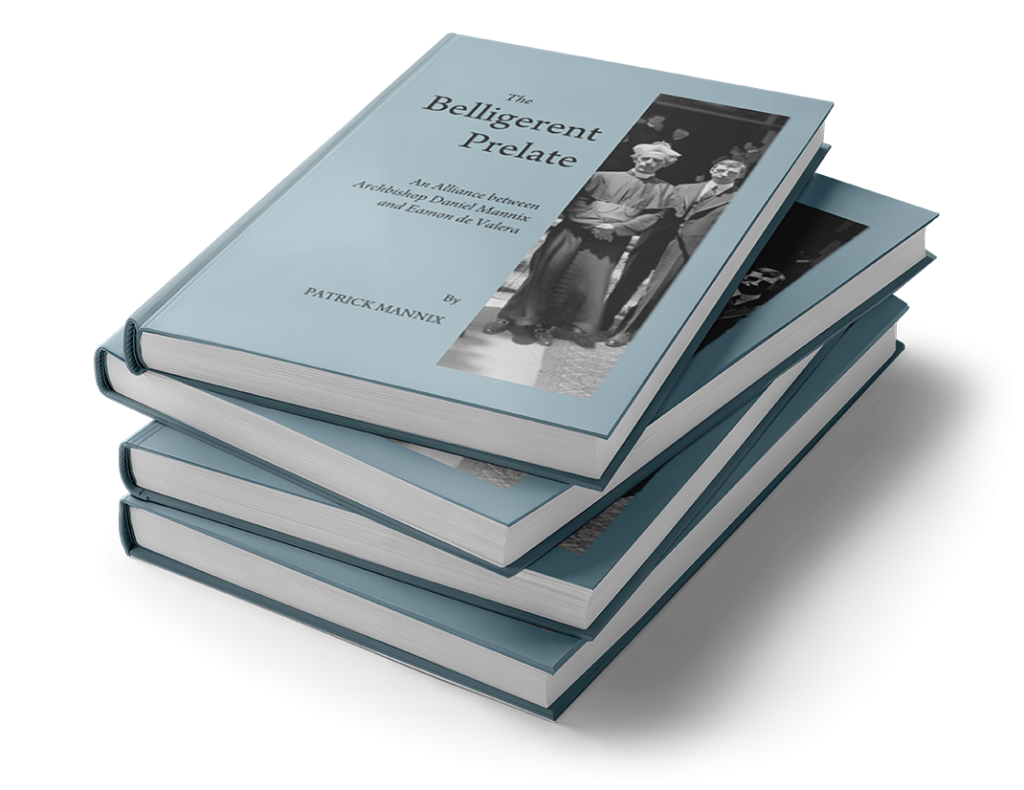
An Alliance between Archbishop Daniel Mannix and Eamon de Valera
This book is an examination and evaluation from a historical perspective of the alliance that was established and forged between the former Taoiseach and President of Ireland, Eamon de Valera, and the former President of Maynooth and Archbishop of Melbourne, Australia, Dr Daniel Mannix. The book explores how their bond aided Ireland’s push for independence and why Mannix, once revered, became an isolated figure after 1925.